
24.08.2026
The yen carry trade is cracking: Japan and the US are caught in the same rate trap
One of the largest and longest-running bets in financial markets is under pressure: the yen carry trade. The combination of a weak Japanese yen, sharply rising interest rates in both Japan and the United States, and recent interventions by both Tokyo and Washington is making this strategy increasingly vulnerable.
The heart of the problem: Japan wants a stronger yen, but has almost no policy tool it can use to achieve this without causing damage elsewhere.
Borrowing where it is cheap
At its core, the yen carry trade is simple. Investors borrow money in Japan, where interest rates are relatively low. They then convert the borrowed yen into dollars and invest the money in US bonds, equities or other assets with a higher expected return.
Suppose borrowing in yen costs 1% and a US Treasury bond yields 5%. That appears to earn an interest rate differential of 4 percentage points. As long as the yen remains stable or weakens further, this strategy works extremely well.
But a carry trade is really a double bet. The investment has to deliver enough, and the yen must not rise too much against the dollar. If the yen suddenly strengthens, more dollars are needed to repay the yen loan. The interest advantage built up over years can then disappear in a matter of days.
Japan is trapped
The weak yen is no accident. The interest rate gap between Japan and the United States is large and makes it attractive to move money out of Japan. That creates additional selling pressure on the yen.
For the Japanese economy, that weak currency is becoming increasingly problematic. Japan imports a great deal of energy and raw materials. These are usually paid for in dollars and therefore become more expensive when the yen weakens. That fuels inflation and hits households in particular through higher prices for fuel, electricity and everyday groceries.
Normally a central bank can support its currency by raising interest rates. But that is precisely where Japan is stuck. The Japanese government has one of the largest debt burdens in the world. Higher interest rates mean that refinancing that debt becomes ever more expensive. In addition, Japanese banks, insurers and pension funds could suffer losses on their large portfolios of existing government bonds.
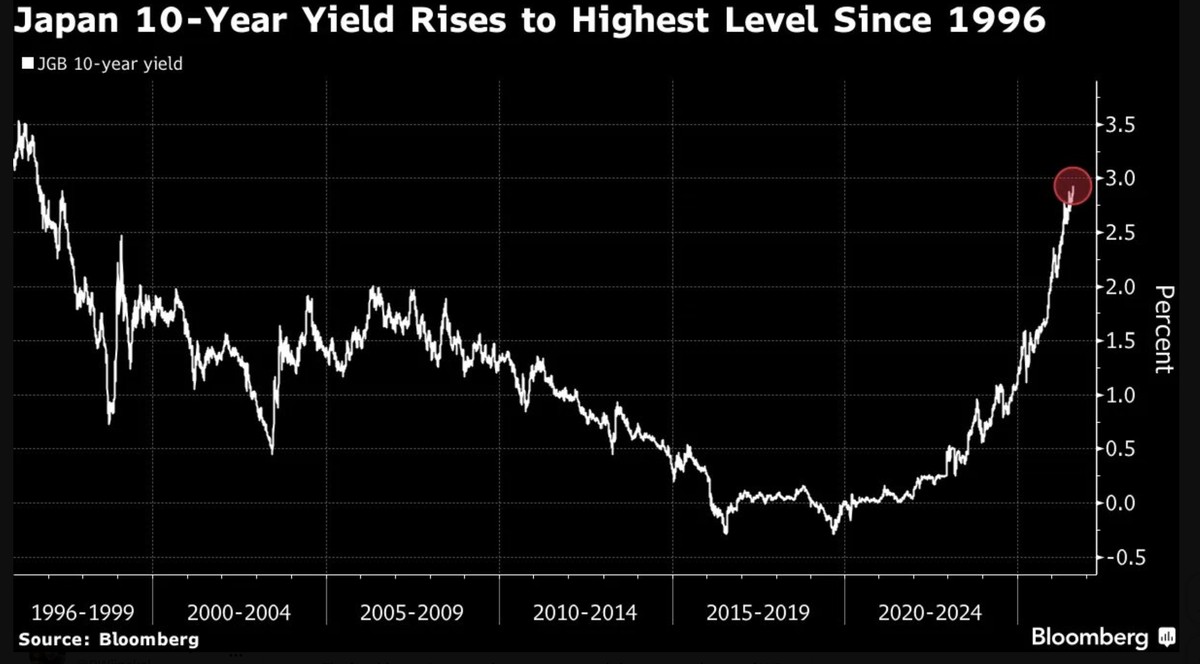
Even so, Japanese interest rates are already climbing quickly. The ten-year yield reached almost 3% this week, the highest level in about thirty years. In effect, the market is forcing tighter financial conditions on Japan, even when the Bank of Japan wants to remain cautious.
The intervention in USD/JPY
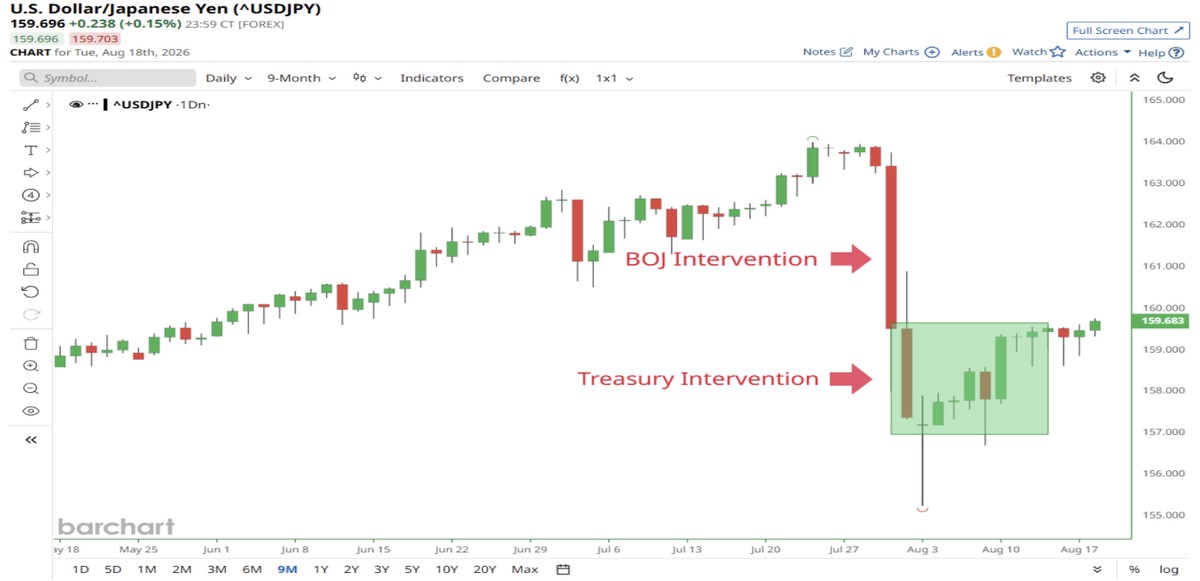
The recent currency intervention cannot be seen separately from this dilemma. At the end of July, Japan and the United States intervened jointly to support the yen. In doing so, other currencies were sold and yen were bought. USD/JPY then fell sharply: one dollar temporarily bought considerably fewer yen.
Japan’s Ministry of Finance confirmed that the intervention had been carried out together with the US Treasury to counter “excessive” and “disorderly” movements in the yen. Tokyo also indicated that further interventions remain possible.
Such an intervention can deter speculators and put carry trades under temporary pressure. Investors who have borrowed yen see their repayment obligation quickly become more expensive when the currency rises. They may be forced to sell US bonds, equities and other investments and buy back yen. That amplifies the move.
But a currency intervention does not change the underlying interest rate differential. As long as US interest rates remain much higher than Japanese rates, the incentive to borrow yen and buy dollars persists. Intervention can buy time, but without a change in interest rate policy it is rarely a definitive solution.
The choice Washington fears
Japan holds enormous currency reserves and is among the largest foreign holders of US government bonds. In theory, Tokyo could fight a weaker yen by selling dollars and buying back yen. But when that requires selling US government bonds on a large scale, a new problem arises.
Additional selling of Treasuries pushes down bond prices and drives US long-term interest rates further up. That is exactly what Washington wants to avoid. The US government has to finance a rapidly growing national debt and therefore depends on sufficient demand for its bonds. Higher rates mean not only higher interest costs for the government, but ultimately also more expensive mortgages, corporate loans and consumer credit.
To avoid forced sales, Japan wants to make use of the US Federal Reserve’s FIMA Repo Facility. This allows Tokyo to temporarily borrow dollars using US government bonds as collateral, without selling those bonds directly on the market. Those dollars can then be sold to buy yen.
That explains why the United States cooperated in the intervention. Washington wants to prevent Japan from having to choose between an uncontrolled weak yen and selling large quantities of Treasuries.
Bessent tries to tame long-term rates
Against this backdrop, US Treasury Secretary Scott Bessent took another striking step on 19 August. The department announced that it would at least double the buyback of government bonds with maturities of 10 to 30 years. From 9 September, the maximum amount rises from $2 billion to at least $4 billion per operation.
The measure followed after the US 30-year yield had reached about 5.3%, the highest level since 2007. By buying back long-dated bonds, the Treasury creates additional demand. Bond prices rise as a result and yields fall. After the announcement, the 10-year yield eased towards 4.65% and the 30-year yield to about 5.2%.
With this, Bessent is trying to manage two flashpoints at once. Lower US interest rates relieve the US government and at the same time narrow the interest rate gap with Japan. That can reduce the pressure on the yen and lessen the appeal of the carry trade. After all, a stronger yen and lower US rates hit carry traders from two sides.
No painless way out
Ultimately, Japan has three options, and all three have clear drawbacks. It can raise interest rates and thereby support the yen, but risks higher interest costs and problems in the Japanese bond market. It can deploy currency reserves, but threatens to put the US bond market under further pressure. Or it can keep intervening with Washington’s support, while the fundamental cause, the interest rate differential, largely remains in place.
For retail investors, this is more than a technical currency story. When large professional players have to unwind their carry trades, they can be forced to sell equities, bonds, cryptocurrencies and other risky investments.
So watch three signals in particular: USD/JPY, the Japanese ten-year yield and the US 10- and 30-year yields. Sharp moves in these markets can be the first indication that the yen carry trade is being unwound further.
The key lesson: with the carry trade, returns are built up slowly, but losses can arise at lightning speed. Bessent and the Japanese authorities are trying to buy time. For now, there is no truly good solution to their shared rate trap.
Written by

Robbie van de Wijnckel
Senior Asset Manager - Authorised Manager
Robbie manages clients' investment portfolios on both a discretionary and advisory basis, and is Lead Investment Manager behind the Andreas Capital Equity and Fixed Income strategies. Equities or bonds, it comes down to well-reasoned, disciplined decisions and to careful stewardship of what clients entrust to the firm. That is also why he oversees client asset protection at Andreas Capital, and he makes sure that everyone who informs or advises clients has the required knowledge and competence.
Robbie has worked in the investment industry since 2006, across both equity and fixed income. He began advising private clients at Fortis Bank and, from 2009, covered the European investment-grade bond market as a Fixed Income Analyst at Van Lanschot. In 2012 he moved to asset manager 2PM in Luxembourg, where he rose to Head of Portfolio Management. There he was responsible for the investment strategy, led a team of five and managed the 2PM Bond fund. He joined Andreas Capital in 2017 as a Senior Asset Manager and has been part of the Authorised Management since April 2026. Robbie holds an MSc in Economics from Tilburg University (2005) and has been a CFA charterholder since 2017.

Reinier Beelaerts van Blokland
Senior Asset Manager
As Senior Asset Manager, Reinier builds and manages investment portfolios, with an emphasis on strategic asset allocation and preserving wealth over the long term. He approaches investing with an engineer's eye: as a graduate from Delft University of Technology and with a background in quantitative risk management, he wants to understand the risks and the construction first, before reaching for the opportunities.
Reinier began his career as a quantitative analyst and spent more than eight years at Swiss Life in Luxembourg, working in asset-and-liability management and in structuring and valuing hedging portfolios for variable annuities. In 2018 he moved into the world of family offices, first as Investment Manager at the single family office Group Nerisa, where he led equity research and portfolio construction. Since April 2022 he has been with Andreas Capital as Senior Asset Manager, managing portfolios on both a discretionary and advisory basis and co-managing the Andreas Capital Equity and Fixed Income strategies. He is a CFA charterholder.
 Back to News