
07.07.2026
Quarterly update July 2026
The global economy remains resilient
The first half of 2026 was characterised by an economy that performed better than many investors had expected at the start of the year. The global economy cooled somewhat in the first quarter of 2026, which temporarily heightened concerns about a possible recession. During the second quarter, however, that uncertainty receded. Tensions in the Middle East did run high, but once the situation stabilised somewhat, sentiment on financial markets improved as well. At the same time, inflation remained stubbornly high. We nonetheless expect month-on-month inflation to ease over the coming months, helped in part by the recent fall in the oil price.
Monetary policy also remained an important theme for investors. In the United States a new Chair of the Federal Reserve was appointed, prompting speculation about the future course of interest-rate policy. The market currently still expects one rate rise in 2026, partly because of persistently high inflation. At the same time, a further cooling in economic data, combined with lower oil prices and easing month-on-month inflationary pressure, could create room for a more accommodative policy later in the year. The rate path therefore remains highly dependent on incoming macroeconomic figures.
Despite geopolitical tensions, equity markets continued to perform strongly. The main driving force behind this rise remains the global wave of investment in artificial intelligence (AI).
Strong results thanks to our positioning in AI
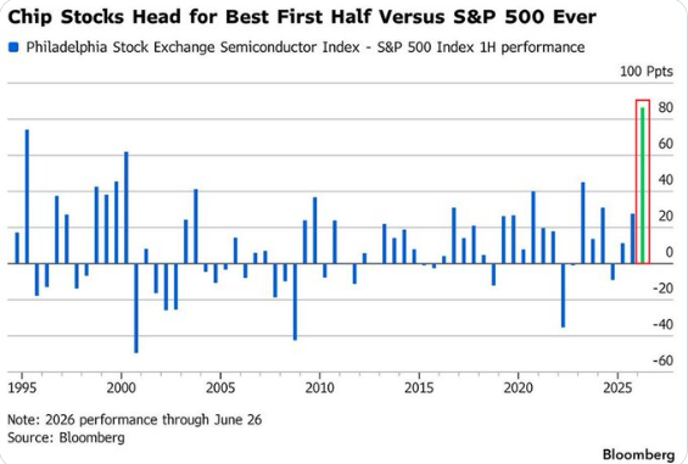
Our portfolios benefited from this development once again and delivered an attractive return over the first half of the year. Our exposure to the semiconductor sector in particular made an important contribution to the result. Companies such as ASML, Applied Materials and LAM Research were once again among the strongest performers in the portfolio. These businesses form the backbone of global AI infrastructure and benefit directly from the enormous investments hyperscalers are making in new data centres.
Precisely because of this exceptionally strong share-price performance, we believe a considerable part of the positive news is now reflected in these companies’ valuations. For that reason we tightened risk management further during the quarter.
On the positions in ASML, Applied Materials and LAM Research we partially wrote call options, securing part of the realised price gains.
We also sold our position in Tokyo Electron in full. We remain positive on the structural outlook for the semiconductor sector, but consider a more selective approach appropriate at this valuation level.
Historical momentum remains notably favourable
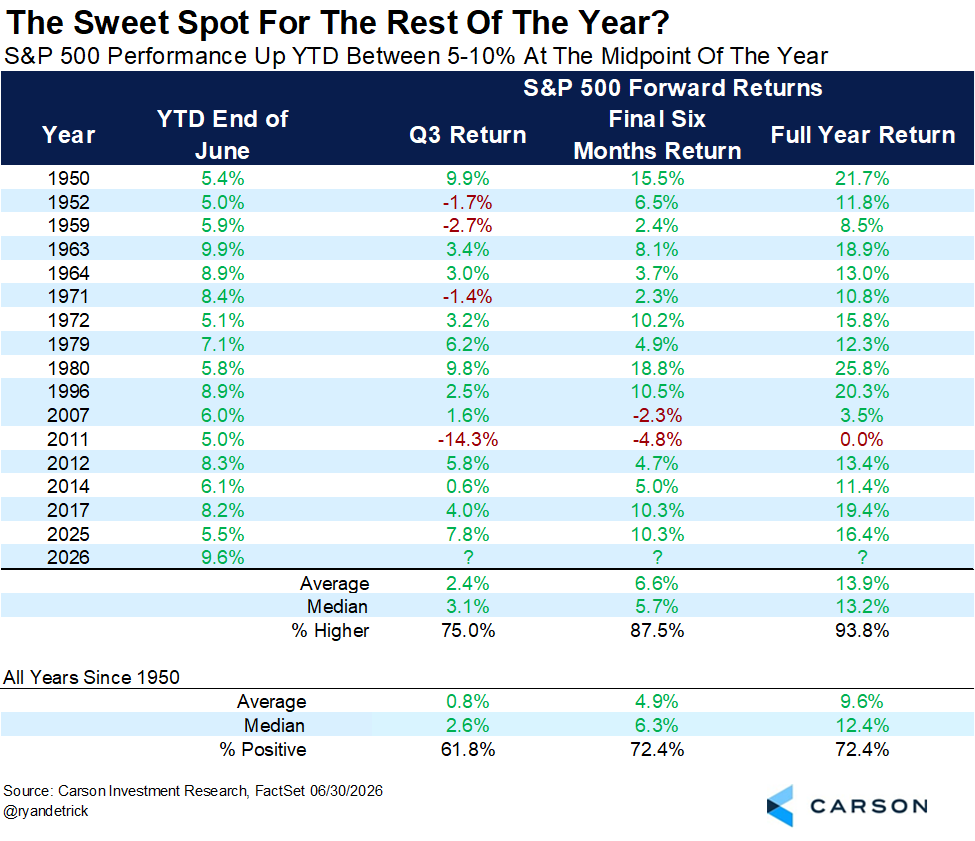
Alongside fundamental developments, we also see reasons from a historical perspective to remain constructive on equities. When the S&P 500 shows a return of roughly 5% to 10% at the halfway point of the year, this has historically proved a particularly favourable starting position for the second half and the year that follows. Since 1950 the index stood higher twelve months later in 93.8% of cases, with an average total return of 13.9%. The average rise over the final six months of the year is approximately 6.6%. The current development of the US equity market again fits within this historical “sweet spot”.
While historical returns are of course no guarantee for the future, these figures underline that strong first half-years do not usually mark the end of a bull market, but rather often coincide with continued positive momentum.
Midterm elections have historically provided additional support
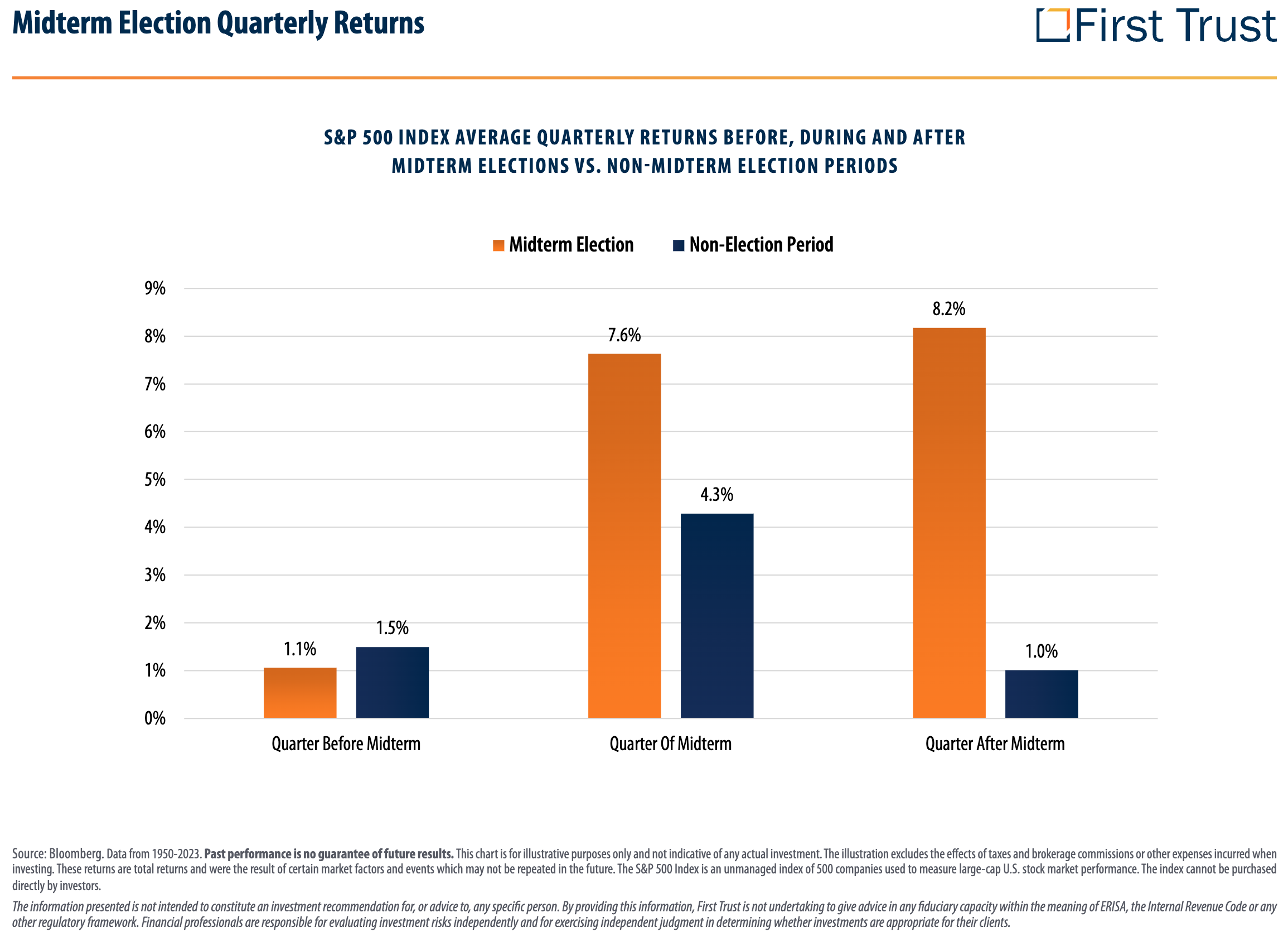
A second factor supporting our positive view is the US election cycle. The run-up to the US midterm elections has historically been accompanied by higher volatility on equity markets. Political uncertainty, debates over budgetary policy and the election outcome can lead investors to adopt a more wait-and-see attitude for a time.
Once that uncertainty is removed, market sentiment generally improves. Historical figures show that both the quarter in which the midterm elections take place and the quarters that follow deliver above-average returns. The first quarter after the elections in particular – in the current cycle the first quarter of 2027 – ranks historically among the strongest periods of the US presidential cycle. This pattern is linked to the easing of political uncertainty and the focus policymakers typically place on economic stability and growth in the second half of the term.
While historical patterns of course offer no guarantee for the future, this election cycle, combined with solid earnings growth and continued investment in AI, is a further argument why we expect the current bull market to be able to continue for some time.
AI remains the principal engine
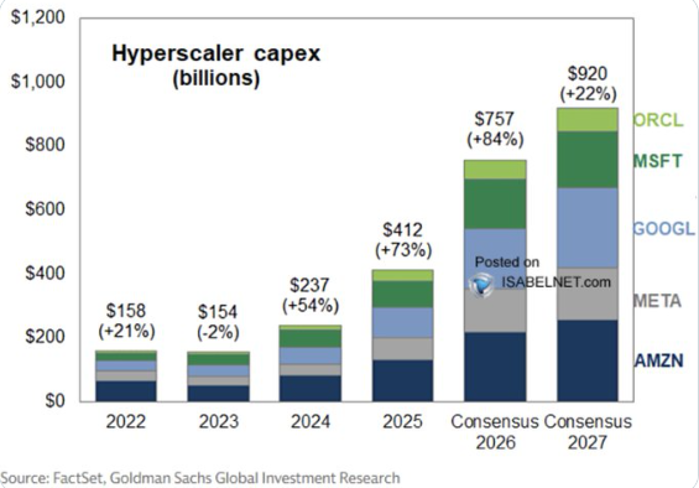
The most important structural growth factor, however, remains artificial intelligence. The five large hyperscalers – Amazon, Microsoft, Alphabet, Meta and Oracle – are expected to invest around $757 billion in new AI infrastructure together this year. For 2027 expectations run as high as approximately $920 billion. Although the growth rate eases slightly compared with this year, this is still an unprecedented investment wave with few parallels in recent economic history.
We have deliberately positioned the portfolio for this. Direct exposure to the hyperscalers has been reduced somewhat. Not because we are less positive about these companies, but because their free cash flow will be under pressure in the coming years as a result of exceptionally high capital expenditure. A greater share of operating profit is, after all, immediately reinvested in new data centres and AI capacity.
At the same time, alongside semiconductors we have added companies that benefit from this investment wave. IREN develops large-scale AI data centres and holds strategic sites with access to low-cost electricity. This allows the company to lease AI capacity to hyperscalers that need additional computing power. Cipher Digital pursues a comparable strategy. The company is converting existing Bitcoin sites into high-quality AI data centres, allowing existing energy infrastructure to be used optimally for AI applications.
Credo Technology forms the connecting link within modern AI data centres. The company develops highly energy-efficient networking solutions that allow thousands of AI processors to communicate with one another efficiently. As AI clusters grow larger, demand for this technology increases sharply.
We expect these companies to be able to benefit to an above-average degree from the continuing investment cycle in AI over the coming years.
Is this a new internet bubble?
We are regularly asked whether the current AI rally is comparable to the internet bubble around the year 2000. Although some parts of the market have now risen very sharply, at index level we do not as yet see broad bubble formation.
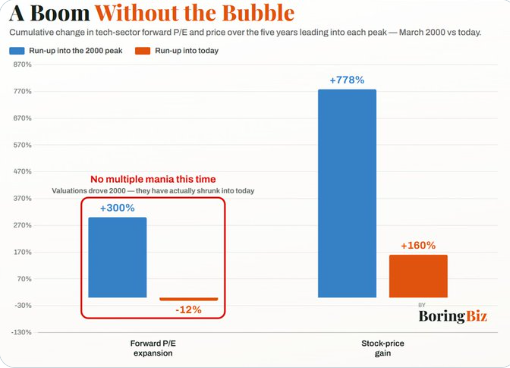
An important difference from the dot-com period is that the current rise in prices is largely supported by earnings growth. Earnings growth of approximately 26% is expected for the S&P 500 in the coming quarterly figures. During the internet bubble, share prices rose mainly because investors were willing to pay ever-higher valuations. Price/earnings ratios rose by hundreds of percent at the time.
The current situation is fundamentally different. The recent rise in the equity market is largely carried by genuinely higher corporate earnings, while valuations at index level have remained relatively stable. Within certain segments, particularly the semiconductor sector, we do of course see clear signs of multiple expansion. That is precisely why we consider active portfolio management essential. By securing profits partially and in good time and reallocating capital to companies positioned earlier in the AI value chain, we seek to preserve return potential without taking on unnecessary additional risk.
Outlook
Our outlook for the second half of 2026 remains constructive. The combination of healthy earnings growth, historically favourable seasonal patterns, the US election cycle and unprecedented investment in AI forms, in our view, a solid foundation for further price gains.
That said, the differences between companies continue to widen. In some sectors valuations now run well ahead of fundamental developments, while attractive opportunities are emerging elsewhere. It is precisely in such a market environment that we believe active portfolio management can make the difference. We therefore continue to look for companies with strong structural growth prospects, while at the same time keeping valuation, risk management and a balanced portfolio firmly in view.
Written by

Robbie van de Wijnckel
Senior Asset Manager - Authorised Manager
Robbie manages clients' investment portfolios on both a discretionary and advisory basis, and is Lead Investment Manager behind the Andreas Capital Equity and Fixed Income strategies. Equities or bonds, it comes down to well-reasoned, disciplined decisions and to careful stewardship of what clients entrust to the firm. That is also why he oversees client asset protection at Andreas Capital, and he makes sure that everyone who informs or advises clients has the required knowledge and competence.
Robbie has worked in the investment industry since 2006, across both equity and fixed income. He began advising private clients at Fortis Bank and, from 2009, covered the European investment-grade bond market as a Fixed Income Analyst at Van Lanschot. In 2012 he moved to asset manager 2PM in Luxembourg, where he rose to Head of Portfolio Management. There he was responsible for the investment strategy, led a team of five and managed the 2PM Bond fund. He joined Andreas Capital in 2017 as a Senior Asset Manager and has been part of the Authorised Management since April 2026. Robbie holds an MSc in Economics from Tilburg University (2005) and has been a CFA charterholder since 2017.
Reinier Beelaerts van Blokland
Senior Asset Manager
As Senior Asset Manager, Reinier builds and manages investment portfolios, with an emphasis on strategic asset allocation and preserving wealth over the long term. He approaches investing with an engineer's eye: as a graduate from Delft University of Technology and with a background in quantitative risk management, he wants to understand the risks and the construction first, before reaching for the opportunities.
Reinier began his career as a quantitative analyst and spent more than eight years at Swiss Life in Luxembourg, working in asset-and-liability management and in structuring and valuing hedging portfolios for variable annuities. In 2018 he moved into the world of family offices, first as Investment Manager at the single family office Group Nerisa, where he led equity research and portfolio construction. Since April 2022 he has been with Andreas Capital as Senior Asset Manager, managing portfolios on both a discretionary and advisory basis and co-managing the Andreas Capital Equity and Fixed Income strategies. He is a CFA charterholder.
 Back to News