
10.12.2025
Outlook 2026
We look at the outlook for 2026 based on recent market developments and themes. Below we discuss the key points for the 2026 investment year, from Fed policy to tech stocks, corporate earnings, liquidity, valuations, investor sentiment and seasonal effects.
FED
The US central bank (the Fed) is expected to cut rates further in 2026. The central bank can only influence short-term rates; the question is how long-term rates will respond. Long-term rates may stay somewhat higher or fall less sharply, causing the spread between short and long (the yield curve) to normalise. Historically, equity returns over a 12-month horizon are often positive when the Fed cuts rates while the S&P 500 is close to a record high (see chart below). A change at the top of the Fed is also being factored in: Chair Jerome Powell’s term expires in May 2026, with Kevin Hassett mentioned as a possible successor. Under the new Fed leadership, monetary policy is expected to become more accommodative and supportive.

Corporate earnings
Corporate earnings were exceptionally strong in the third quarter of 2025. Many companies beat expectations with higher revenues and profits. Analysts expect this growth to continue in 2026. For the S&P 500, for example, around +14% earnings growth is expected. Margins also continue to rise and are approaching a historic record. These record-high margins mean companies are controlling costs and are highly profitable, which is positive for shareholders. Sustained earnings growth and high margins form a solid foundation for further price development in 2026.
Magnificent 7
The seven largest US tech companies, also known as the “Magnificent 7”, have again outperformed the broad market this year. These megacaps pulled the market higher and outpaced the index in terms of growth. The question is whether they can maintain this pace, as expectations and valuations are already high. A key advantage is that these companies are investing heavily in AI and cloud infrastructure, which can strengthen their future growth and return on invested capital. But therein also lies the risk. Bank of America estimates that data-centre investment will double over the next ten years, driven by the AI boom. This points to growth opportunities in themes such as chip producers and data-centre infrastructure, which benefit from the enormous demand for computing power. Some analysts warn of bubble formation among these tech giants, but so far the price gains have been backed by equally strong earnings gains (see right-hand chart below). In other words, the rally is driven by fundamentals such as higher corporate earnings rather than mere hype.

Liquidity
Liquidity in the financial markets is currently still ample. A great deal of capital is circulating in the system, partly thanks to the stimulus policy of recent years. Central banks are reducing their balance sheets (quantitative tightening) and governments are increasing bond issuance, which can withdraw liquidity from the markets. The Fed has already indicated that it will stop QT as of 1 December 2025, which has a positive effect on liquidity. We may reach a peak in liquidity in 2026 (see chart below). Less generous liquidity conditions could put some pressure on the valuations of financial assets, although the situation remains supportive for now.

Valuations
US equity markets are relatively expensive compared with historical benchmarks and other regions. The S&P 500 trades at a price-earnings ratio (P/E) of around 23. According to analyses by JPMorgan, such a high valuation implies an expected annual return of only around –2% to +2% over the next ten years. In other words, from the current level, the long-term return for US equities is likely to be limited. By comparison, equities in other regions (for example Europe and emerging markets) have lower valuations, which points to potentially higher future returns there (see below). It should be noted, however, that the high US valuations are partly justified by strong underlying corporate earnings growth. Thanks to these rising profits, the high prices are better underpinned, which differs from a pure bubble in which prices are detached from the fundamentals.

Sentiment
Notably, investor sentiment remains rather negative despite the strong market performance. Surveys, such as the AAII survey of US retail investors, show that there are still more “bears” (pessimists) than “bulls” (optimists) in the market. This negative sentiment indicates that many investors are cautious and reticent. Such a conservative stance may mean that there is still money on the sidelines and that euphoria is absent. From a contrarian perspective, gloomy sentiment even offers opportunities: when the mood is this cautious, better-than-expected news can create a positive surprise and additional price gains, as investors may have to adjust their positioning if the outlook improves.

Seasonality
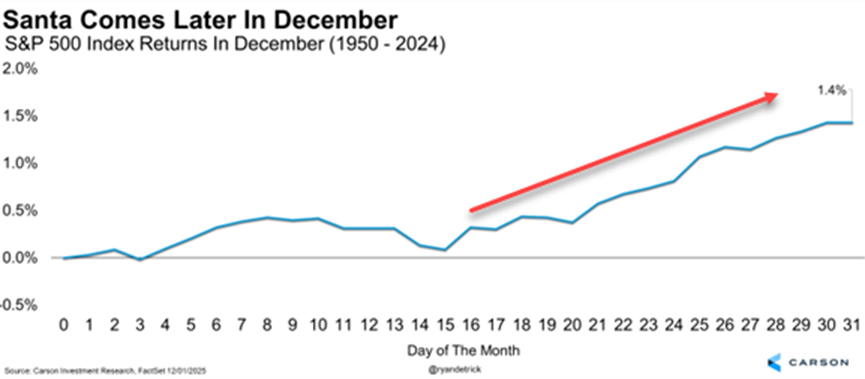
The final factor is the seasonal effect. Historically, equity markets often experience a strong year-end rally. Particularly in the second half of December, prices show a positive pattern on average. This so-called “Santa Claus rally” means that the market gets an extra boost in the final days of the year. For investors, this means that 2025 could potentially end on a positive note. Such a positive seasonal trend at the end of the year can boost confidence and set a favourable tone for the start of 2026.
Conclusion:
The outlook for 2026 presents a mixed picture. On the one hand, many companies continue to perform solidly and the market is factoring in possible rate cuts by the Federal Reserve. Investor sentiment is rather cautious, which can actually act as support from a contrarian point of view. In addition, the traditional seasonal effect in December provides extra tailwind into the first quarter of 2026. On the other hand, there are high equity valuations and signals that liquidity growth may reach its peak in 2026. All things considered, the current bull market appears able to continue for some time yet. In 2025, we saw that non-profitable companies in particular performed exceptionally strongly, while quality stocks lagged behind. From a historical perspective, this is the exception rather than the rule. When market dynamics shift, it is usually precisely the companies with strong balance sheets, sustainable competitive advantages and predictable cash flows that take the lead again. This aligns closely with our long-term strategy: investing in quality as an anchor, precisely in markets with increasing divergence between hype and fundamental value. Too one-sided a focus on the Magnificent Seven, for example, can be severely punished in a correction, while completely avoiding more expensive technology companies can equally result in prolonged underperformance. A gradual reallocation, taking profits step by step on strongly appreciated positions and shifting capital to more attractively valued segments, offers a pragmatic way to reduce risk in 2026. At the same time, experience teaches that extreme valuation differences never persist indefinitely. Although it is impossible to predict whether normalisation will be abrupt or gradual, it is clear that it will come. That is why it is wiser for investors to reallocate gradually rather than abruptly: systematically taking profits on positions that have risen to extremes and shifting capital to high-quality companies that have lagged too far behind. This approach offers protection and prepares the portfolio for the moment when quality is rewarded again.
Written by

Robbie van de Wijnckel
Senior Asset Manager - Authorised Manager
Robbie manages clients' investment portfolios on both a discretionary and advisory basis, and is Lead Investment Manager behind the Andreas Capital Equity and Fixed Income strategies. Equities or bonds, it comes down to well-reasoned, disciplined decisions and to careful stewardship of what clients entrust to the firm. That is also why he oversees client asset protection at Andreas Capital, and he makes sure that everyone who informs or advises clients has the required knowledge and competence.
Robbie has worked in the investment industry since 2006, across both equity and fixed income. He began advising private clients at Fortis Bank and, from 2009, covered the European investment-grade bond market as a Fixed Income Analyst at Van Lanschot. In 2012 he moved to asset manager 2PM in Luxembourg, where he rose to Head of Portfolio Management. There he was responsible for the investment strategy, led a team of five and managed the 2PM Bond fund. He joined Andreas Capital in 2017 as a Senior Asset Manager and has been part of the Authorised Management since April 2026. Robbie holds an MSc in Economics from Tilburg University (2005) and has been a CFA charterholder since 2017.
 Back to News